Laboratory testing is a fundamental pillar of geotechnical engineering in Anchorage, providing the quantitative data needed to characterize subsurface materials and predict their behavior under load. This category encompasses a comprehensive suite of physical and mechanical tests performed on soil and rock samples retrieved from the field, transforming them into actionable parameters for foundation design, slope stability analysis, and pavement construction. In a region where permafrost, glacial deposits, and seismic hazards converge, accurate laboratory results are not a luxury but a necessity for safe and durable infrastructure.
Anchorage sits atop a complex mosaic of Quaternary deposits, including glacial till, outwash sands and gravels, silty loess, and extensive layers of discontinuous permafrost. The presence of ice-rich soils and frost-susceptible silts demands careful evaluation of thaw settlement, frost heave, and strength loss upon warming. Laboratory tests such as the residual soil characterization and unconfined compression test (UCS) help engineers quantify these critical parameters, while the oedometer consolidation test provides precise data on compressibility and thaw-consolidation behavior unique to cold regions.
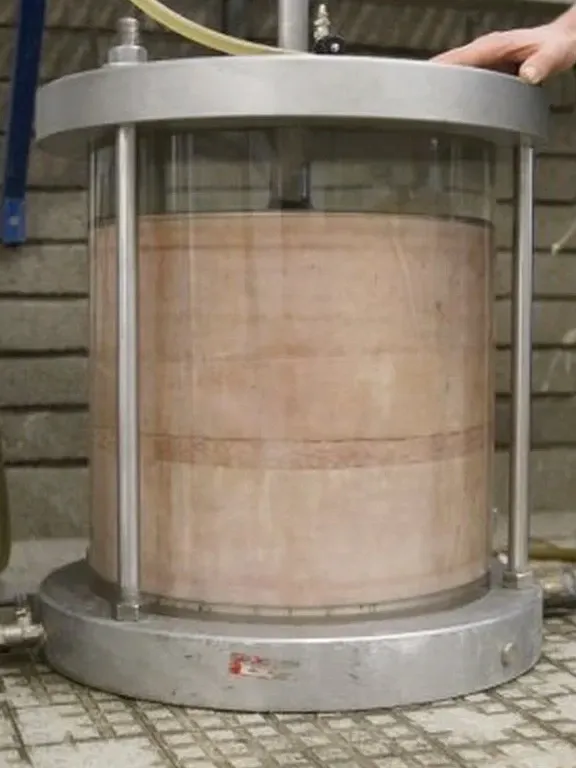
All laboratory work in Anchorage must conform to ASTM International standards, which are the prevailing norm in the United States. Key standards include ASTM D698 and D1557 for compaction (Proctor tests), ASTM D3080 for direct shear, ASTM D2850 for unconsolidated-undrained triaxial tests, and ASTM D1883 for the California Bearing Ratio (CBR) test. Local building codes, such as the 2018 International Building Code (IBC) as adopted by the Municipality of Anchorage, also reference these standards and require site-specific laboratory data for geotechnical reports submitted with permit applications.
Projects that routinely require extensive laboratory testing in Anchorage include residential and commercial developments on hillsides and infill lots, road and airport runway expansions (e.g., at Ted Stevens Anchorage International Airport), utility trench backfill for water and sewer lines, and remediation of contaminated sites. The direct shear test and triaxial test are particularly common for evaluating shear strength along potential failure planes in cut slopes and retaining wall backfill. For pavement design, the laboratory CBR test and Proctor test (Standard or Modified) provide essential data for subgrade and base course design.
Available services
Residual soil characterization
→ Ver detalleUnconfined compression test (UCS)
→ Ver detalleOedometer consolidation test
→ Ver detalleDirect shear test
→ Ver detalleLaboratory CBR test
→ Ver detalleProctor test (Standard or Modified)
→ Ver detalleTriaxial test
→ Ver detalleSoil mechanics study
→ Ver detalleAtterberg limits
→ Ver detalleLaboratory permeability test (falling/constant head)
→ Ver detalleFrequently asked questions
What is the typical turnaround time for standard laboratory tests in Anchorage?
Turnaround times vary by test complexity. Basic tests like Proctor compaction or moisture content often yield results within 3–5 business days. More advanced tests such as triaxial or consolidation can take 2–4 weeks, depending on the number of load increments and drainage conditions.
How does permafrost affect laboratory test results for soils in Anchorage?
Permafrost soils require special handling to preserve their frozen structure during transport and testing. Thawing can drastically reduce strength and increase compressibility. Laboratory tests must replicate in-situ temperature and stress conditions, often using chilled equipment and rapid shearing to capture the true behavior of ice-bonded soils.
Are there specific ASTM standards that are most critical for Anchorage projects?
Yes. ASTM D698 and D1557 (Proctor), D3080 (direct shear), D2850 (triaxial), and D1883 (CBR) are widely used. For permafrost, ASTM D5520 (unfrozen water content) and D4083 (sample handling) are also essential. All must be followed strictly to ensure acceptance by local building officials.
Why is a soil mechanics study important before starting construction in Anchorage?
A soil mechanics study integrates laboratory data with field observations to assess bearing capacity, settlement, frost susceptibility, and seismic liquefaction potential. Without it, foundations may heave, settle, or fail during an earthquake, leading to costly repairs or unsafe conditions. It is the cornerstone of any responsible geotechnical investigation.